


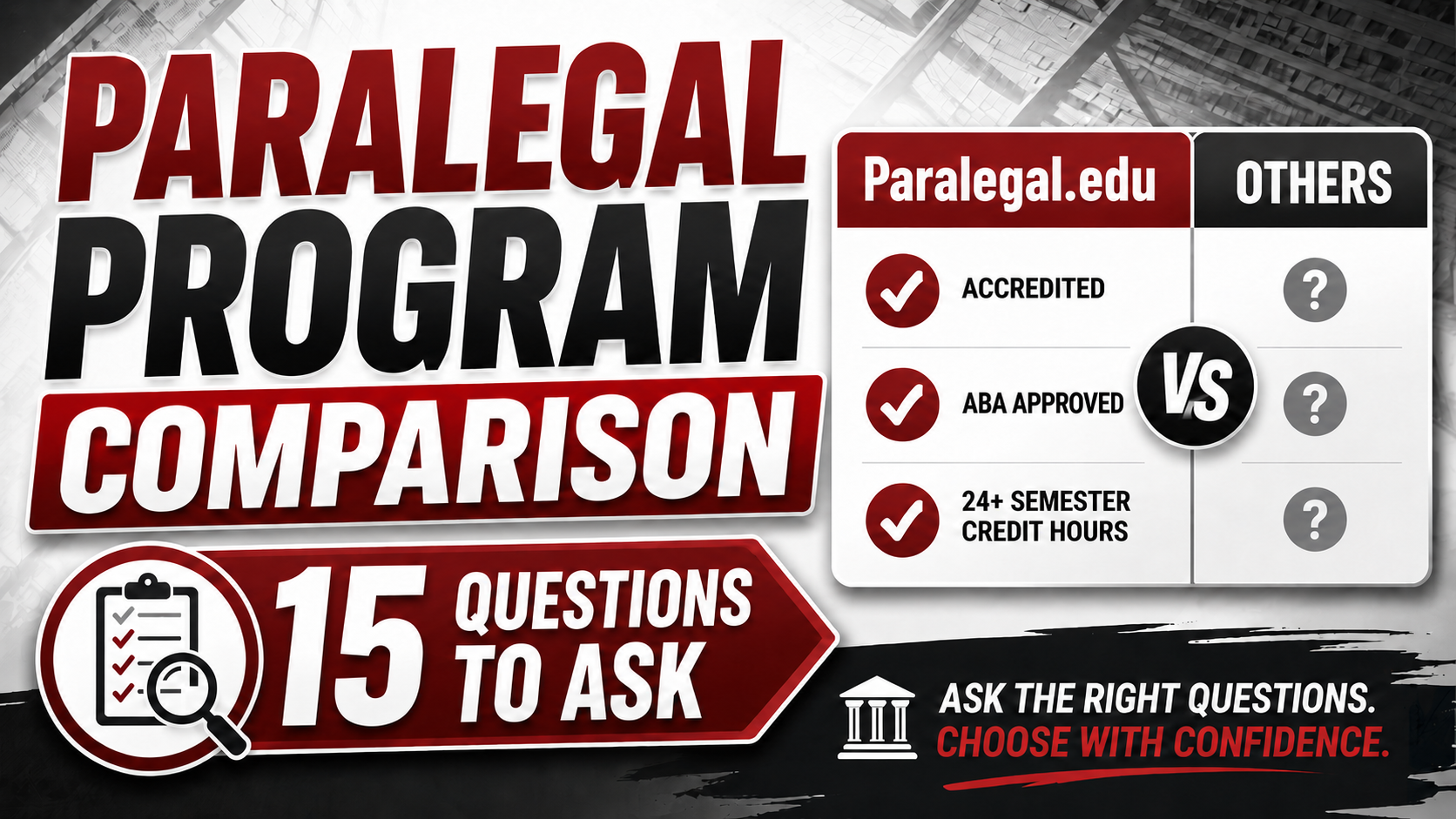
Choosing a paralegal program is an important decision. The right program can help you build the legal knowledge, practical skills, academic credentials, and career confidence needed to enter this exciting profession. The wrong program may leave you with fewer options, limited support, non-college credit, or training that does not meet industry expectations. Paralegal program comparison can be difficult.
 Before enrolling, take the time to carefully compare paralegal programs. Look beyond advertising claims and ask direct questions about accreditation, ABA approval, program length, law specialty coursework, online learning, financial aid eligibility, VA benefits, career services, college credit, employment outcomes, and refund policies.
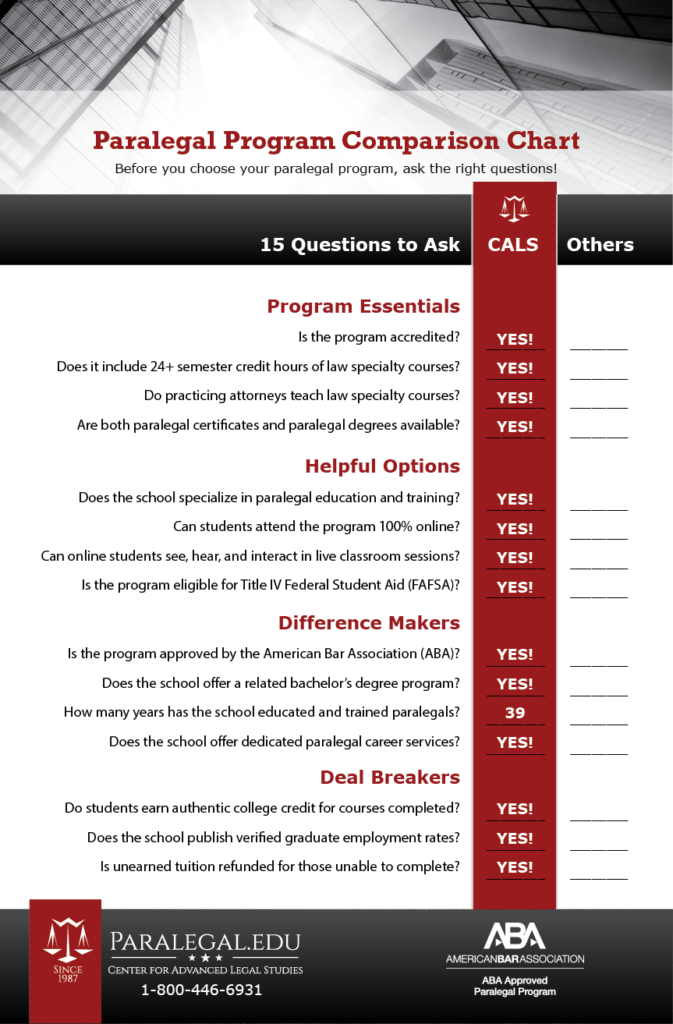
At Paralegal.edu | Center for Advanced Legal Studies, we believe students deserve clear, honest information before making a decision. That is why we have created a free Paralegal Program Comparison Chart to make the process a little easier to understand. [Download the PDF]
Why Paralegal Program Comparison Matters
Not all paralegal programs are the same. Some are short-term training courses or non-credit continuing education programs. Others are accredited college-level programs that award academic credit. Some are ABA-approved while others are not. Many programs are fully online, while others require campus attendance. Some are taught by experienced, practicing attorneys, while others may rely more on non-licensed staff.
A meaningful comparison before enrollment helps you understand what you are actually receiving.
When comparing paralegal schools, ask whether the program offers the essentials you need now and the credentials that may matter later.
Before choosing a paralegal program, start with the fundamentals.
Is the program accredited?
Accreditation matters because it reflects institutional oversight, academic standards, and accountability. Students should confirm whether the program is accredited and if the credential they earn will be issued by an accredited institution or by their continuing education department (non-credit).
Does the program include substantial law specialty coursework?
A paralegal education should include meaningful legal instruction. Programs that include 24 or more semester credit hours of law specialty courses provide focused preparation in legal subjects that paralegals are likely to encounter in the workplace. The American Bar Association (ABA) requires at least 18 semester credit hours in law specialty courses, and the State of California requires at least 24 semester credit hours for non-ABA-approved programs.
Are law specialty courses taught by practicing attorneys?
Legal education is stronger when students learn from instructors with real-world legal experience. Practicing attorneys can help connect legal theory to practical application. Ask not only have many attorneys teach in the program, but how long they have taught. Experience matters.
Are both paralegal certificates and paralegal degrees available?
Students have different educational goals. Those who have already earned a college degree should seek focused paralegal certificate training. Those without a degree should pursue a paralegal degree for a more comprehensive preparation to enter the profession and to meet the requirements suggested by paralegal authorities and required by the ABA. A school that offers both certificate and degree options can provide more flexibility for students with different needs.
Once the essentials are clear, compare options to make the program more accessible and practical.
Does the school specialize in paralegal education?
A school specializing in paralegal education focuses on preparing students to enter the paralegal profession above all else. Specialized schools generally offer a more concentrated curriculum, legal career guidance, and instructors familiar with the paralegal profession. What’s more, schools that focus on paralegal training will devote the majority of their resources to paralegal students. In many college systems, the paralegal studies department is relatively small with limited resources.
Can students attend 100% online?
Online learning can make paralegal education more accessible for working adults, parents, military-connected students, and students who do not live near campus. But not all online programs are the same. Some emphasize live, synchronous instruction while others more closely resemble correspondence programs.
Can online students see, hear, and interact in live classes?
A strong online program should offer more than static content. Live, interactive classes can help students ask questions, engage with instructors, and participate in a more connected learning experience. Paralegal.edu | Center for Advanced Legal Studies utilizes Class for Teams for all live, online classes.
Is the program eligible for Title IV Federal Student Aid?
Federal Student Aid eligibility can be an important consideration for students who need help financing their education. Students should confirm whether the program is Title IV-eligible (FAFSA) before enrolling. Non-accredited programs may advertise ‘financial assistance’ as being available, but this is often in the form of 3rd-party private loans, which can have steep origination fees and stringent credit score and co-signer requirements.
After comparing the basics, look for features that may further set one program apart from another.
Is the program approved by the American Bar Association?
ABA approval is an important distinction in paralegal education. While not every quality program is ABA-approved, students should understand whether a program has this recognition and how it may affect their educational and career goals. Virtually all attorneys attended an ABA-accredited law school. The ABA doesn’t accredit paralegal programs, they approve them. This familiarity can be important and comforting to many employers. Beware of programs that state they elected not to pursue ABA approval. It is more likely their programs didn’t meet the program length or other ABA guidelines to qualify.
Does the school offer a related bachelor’s degree program?
A related bachelor’s degree option can be valuable for students who want to continue their education after completing a certificate or associate-level credential. Center for Advanced Legal Studies provides a Bachelor of Law and Business degree program that takes just 20 months to complete after earning an associate degree. Designed for CALS associate degree graduates, it is also available to graduates of other accredited paralegal associate degree programs.
How long has the school been educating and training paralegals?
Experience matters. A long-standing history in paralegal education can reflect institutional stability, employer familiarity, and curriculum development. Center for Advanced Legal Studies has educated and trained paralegals since 1987. During this time, paralegal programs have been shaped by ongoing feedback and contributions from an active Program Advisory Committee comprised of attorneys and paralegals, input from employers and graduates, and the inclusion of new course topics and technologies.
Does the school offer dedicated paralegal career services?
Career support should be specific to the legal field. Dedicated paralegal career services can help students and graduates with resumes, job‑search strategies, interview preparation, employer connections, and long‑term career planning. Look for more than just a job board or generic pamphlets on resume writing – strong programs offer specialized guidance tailored to legal careers. Ask whether the school has dedicated staff responsible for actively assisting graduates in finding employment, including building relationships with hiring law firms and corporate legal departments.
Some questions are too important to overlook. These may be deal breakers when comparing programs.
Do students earn authentic college credit?
Students should know whether completed courses result in actual college credit. This can matter for transfer, future education, employer recognition, and long-term academic planning. Beware of programs that charge a premium for non-credit courses. Is your investment providing you with real, lasting value?
Does the school publish verified graduate employment rates?
Employment outcomes should be transparent. Schools that publish verified graduation and graduate employment rates provide students with more information when evaluating potential return on investment. When a school openly shares its results, it signals accountability, credibility, and confidence in the effectiveness of its training.
Is unearned tuition refunded if a student cannot complete?
Life happens. Students should understand refund policies before enrolling, including whether unearned tuition is refunded if they are unable to complete the program. Ask to see their refund policy before enrolling. You should only be responsible for paying for the tuition, books, and fees related to courses you complete or attempt.
A paralegal program is more than a class schedule. It is an investment of time, money, effort, and trust. Before enrolling anywhere, compare programs side by side and ask the questions that matter most:
Are you earning college credit?
Is the program accredited?
Is the program ABA-approved?
Can you attend online and still participate in live classes?
Are practicing attorneys teaching your law courses?
Are career services focused on paralegal employment?
Are outcomes and refund policies transparent?
These questions can help you make a more informed decision.
Of course, this Paralegal Program Comparison Chart might seem a little biased. It highlights attributes that Paralegal.edu | Center for Advanced Legal Studies considers most important. Still, it is difficult to argue with the reasoning behind these criteria or with the program features they emphasize – all of which you will find offered at Paralegal.edu.
Before choosing a paralegal school, use our comparison chart to ask the right questions and evaluate your options honestly.
Compare accreditation. Compare ABA approval. Compare online learning. Compare career support. Compare outcomes. Compare value.
Then choose the program that best fits your needs and goals. Paralegal.edu hopes to be included among your considered options.